Most people think building muscle requires a big budget: expensive supplements, imported food, a membership at the nicest gym in town. It doesn't. Muscle is built by science, not by money.
I'm Coach Ali Baddour. I train, eat and coach here in Syria, under the same conditions you do. I built my own physique with the simplest equipment available, and everything in this guide is something I have either done myself or written for a client.
This is a complete, practical plan for building muscle at the lowest cost possible — whether you're in Lattakia, Damascus or Aleppo.
The equation everything else sits on
Muscle growth equals
Resistance training + enough protein + a small calorie surplus + good sleep + consistency
There is no supplement that replaces any part of that equation. Supplements are the last five percent. The other ninety-five is food, training and time.
Training without spending much
Train at home if a gym membership isn't realistic
You don't need expensive machines. This short list covers everything you need to build real strength.
Item
Approx. cost
What it covers
Adjustable dumbbells
$30–50
Almost every muscle group
Barbell and plates
$50–80
The main compound lifts
Resistance bands
$5–10
Accessory and warm-up work
Doorway pull-up bar
$10–15
Back and arms
Prices are approximate as of September 2026 and move with the market.
If even that is out of reach, these work:
Full water bottles or jerry cans as weights
A sack of rice or flour for rows and carries
A sturdy chair for dips and step-ups
Your own bodyweight: push-ups, squats, planks, lunges
If you want a gym, negotiate
Many gyms here charge less for morning or off-peak slots. Some owners will cut the price in exchange for help coaching beginners. Small, unknown gyms are usually far cheaper than the popular ones and the equipment is often identical.
Three or four sessions a week is enough
You do not need to train every day. Three focused sessions a week build excellent muscle. Here is the simplest split that works:
Day 1 — Push: chest, shoulders, triceps
Day 2 — Pull: back, biceps
Day 3 — Legs and core
Remaining days: rest or an easy walk
Eating for muscle on a Syrian budget
This is the part that decides your result. Training is the stimulus; food is the material.
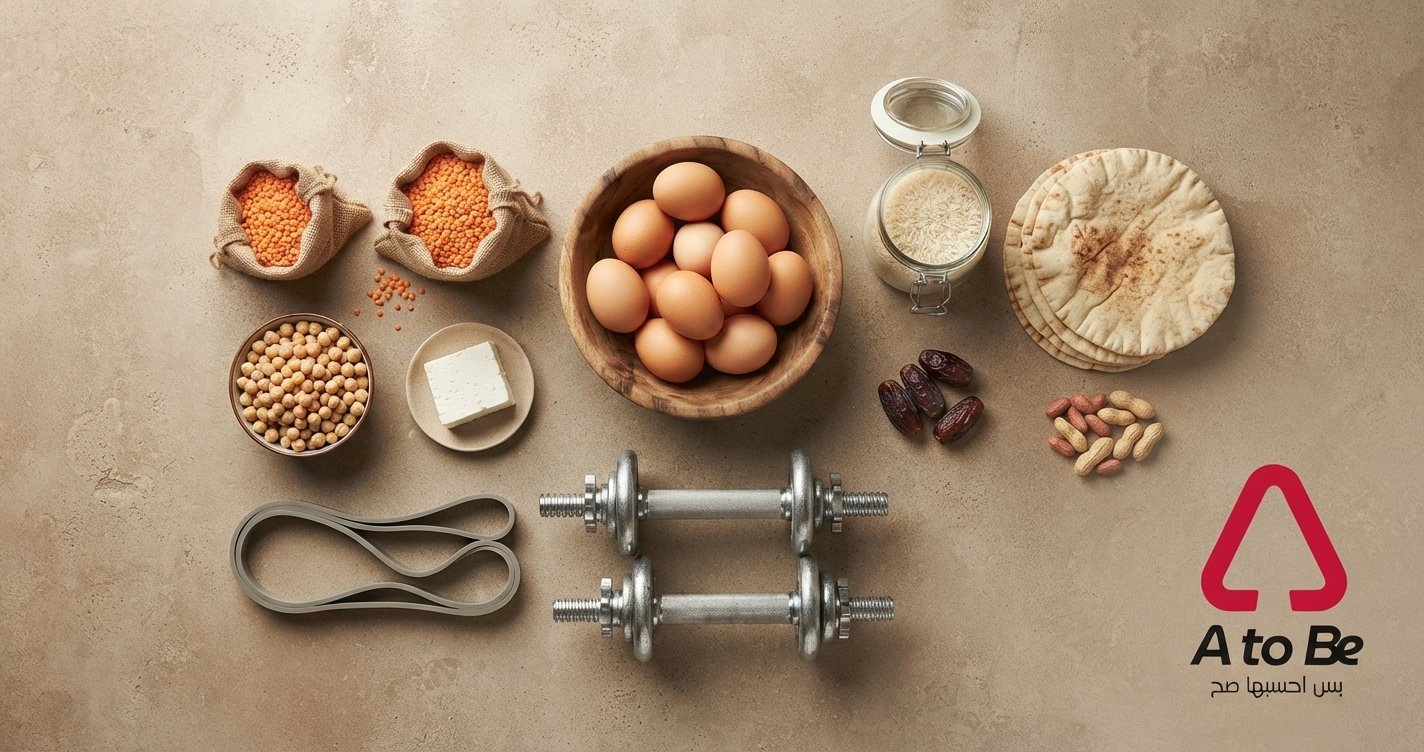
Cheap protein sources available in any Syrian market
Food
Protein per 100 g
Price bracket
Eggs
13 g
Very cheap
Lentils
9 g
Cheap
Chickpeas
8 g
Cheap
Fava beans
8 g
Cheap
Chicken liver
20 g
Cheap
Yoghurt
3.5 g
Moderate
White cheese
15 g
Moderate
Canned tuna
20 g
Moderate
Chicken breast
25 g
Moderate to high
Build your week on eggs, lentils and yoghurt, then add chicken or meat two or three times a week if the budget allows.
A low-cost day that reaches roughly 120 g of protein
Breakfast — 3 boiled eggs, a cup of yoghurt, brown bread. Around 30 g protein.
Mid-morning — a handful of peanuts or boiled chickpeas. Around 10 g.
Lunch — 150 g cooked lentils, a cup of rice, a vegetable salad. Around 19 g.
Before training — a cup of yoghurt and a banana. Around 8 g.
After training — a tin of tuna and a boiled potato. Around 23 g.
Dinner — 3 eggs, 50 g white cheese, brown bread. Around 29 g.
Carbohydrates and fats
Carbohydrates: rice, bulgur, brown bread, potatoes, oats, dates. Bulgur is often the cheapest and the most filling of them. Fats: olive oil, peanuts, tahini and sesame, and local nuts in small amounts.
What you don't actually need
Expensive supplements. Whey, creatine and amino acids are useful, not necessary. You can build excellent muscle without a single one of them if you eat enough. The exception is a genuine deficiency — vitamin D or magnesium — and that is a conversation with your doctor, not a purchase decision.
Imported food. You do not need quinoa, avocado or Norwegian salmon. Lentils, eggs and yoghurt build the same muscle.
Complicated machines. Squats, deadlifts, presses and pull-ups build most of your body. Everything else is refinement.
Five ways to spend less
Buy in bulk. A tray of thirty eggs costs less per egg. Lentils and rice by the kilo cost less than packaged. Find the wholesale market in your city.
Cook at home. Ready food costs more and delivers less. Cook one large batch for three days and save both money and time.
Buy in season. Vegetables and fruit in season are cheaper and better.
Share a membership. Some gyms allow two people to split one subscription — ask.
Buy gradually. Start with one piece of equipment and add over months. Nobody needs a full home gym on day one.
A note on training with diabetes
From my own experience
I live with diabetes myself, so this is not theory to me. If you do too, four things matter: build your carbohydrates around complex sources like bulgur, oats and sweet potato; spread your food across five or six smaller meals; check your blood sugar before and after training; and talk to your doctor before making any large change to how you eat or train.
Your first three months
Month one — foundation. Train three times a week. Spend it learning the movements properly, not chasing weight. Hit 100 to 120 g of protein daily. Sleep seven to eight hours.
Month two — progression. Add weight or repetitions gradually. Raise protein to 130–150 g. Add a fourth session if you're recovering well.
Month three — consolidation. Keep progressing slowly. Track with photos and measurements, not the scale alone. Adjust the plan to what the results actually show.
What to realistically expect: a committed beginner sees a clear change in strength and size over three months. The exact numbers depend on your age, your food, your sleep and your genetics — anyone who promises you a fixed figure is selling something.
The short version
Train three or four times a week, built around the basic compound lifts.
Get your protein from eggs, lentils, yoghurt, chickpeas and tuna.
Get your carbohydrates from rice, bulgur, potatoes and brown bread.
Get your fats from olive oil, peanuts and tahini.
Sleep seven to eight hours.
Stay consistent. Consistency beats every supplement on the shelf.
Don't wait until you can afford more. Start with what you have and build from there.
Want a plan written for your body and your budget?
I write personal training and nutrition programs online, with the cost of your food taken into account — not a template.
This article is general education, not medical advice. If you have a health condition or a current injury, speak to your doctor before starting any training or nutrition plan.
Knee Pain in the Gym: How to Train Around It Instead of Quitting
Knee pain is the single most common complaint among people who lift, beginners and experienced lifters alike. Most of them reach the same conclusion: stop training until it goes away.
That is usually the wrong move. In most cases the knee doesn't need rest — it needs the muscles around it to get stronger, and it needs you to stop doing the two or three specific movements that are irritating it.
This article covers why the knee hurts, when to stop and see someone, and how to keep training while it recovers.
Why your knee hurts
The muscles around it are too weak
When the quadriceps are weak, the joint takes load the muscle should be absorbing. When the hamstrings lag far behind the quads, the imbalance pulls on the joint. Weak calves reduce how stable the knee is under load. Most gym knee pain starts here.
The movement itself is wrong
Dropping below ninety degrees in the squat before you have the control for it
Letting the knee travel well past the toes
Loading heavy before the technique is reliable
No warm-up, no stretching
Going straight to a heavy working set, and leaving the gym without stretching the quads and hamstrings, both add up over months.
Extra bodyweight
Every extra kilogram you carry is multiplied several times over through the knee with each step, and more again on stairs and in the squat.
Something inside the joint
Cartilage wear, an old ligament injury, patellar tendonitis. This category is not something an article can diagnose — it is the reason the next section exists.
Stop and see a professional if
The knee swells suddenly · a click or pop comes with sharp pain · you cannot straighten it fully · the pain has lasted more than two weeks · the joint feels like it might give way.
These are not signs to train around. Everything below applies to mild or moderate pain only, and only once a doctor has ruled the serious causes out.
Swap the painful lifts, don't stop lifting
You are not stopping training. You are replacing the two or three movements that hurt with versions that don't.
Painful
Swap to
Deep barbell squat
Bodyweight squat, or hack squat through a short range
Full-range Romanian deadlift
Shorter range, plus direct hamstring work
Full-range leg press
Leg press limited to 0–60 degrees
Walking lunges
Step-ups onto a low box
Strengthen what surrounds the joint
This is the part that actually fixes the problem. A strong muscle protects the joint — the knee doesn't need to be avoided, it needs to be trained intelligently.
Quadriceps, pain-free range only
Leg extension, light, through 45–90 degrees rather than the full range
Wall sit, 20 to 30 seconds
Step-ups onto a low box
Hamstrings
Leg curl, moderate weight
Glute bridge on the floor
Romanian deadlift, light and short-range
Calves and glutes
Standing and seated calf raises
Hip thrust, light
Clamshells with a band, and side leg raises
Fix the technique
In the squat. Track the knee over the direction of your toes and don't let it collapse inward. Don't let it drift far past the toes. Lower over about three seconds and come up at a controlled speed. Keep the chest up and the back straight.
In the leg press. Don't lock the knee at the top. Don't go past ninety degrees while the knee is painful. Place your feet in the middle of the platform rather than high on it.
In the deadlift. Push the hips back instead of bending the knee more. Start light enough that the pattern is right before the weight is heavy.
Warm up, stretch, and support the joint
Five to ten minutes before. Stationary bike with no resistance, a brisk treadmill walk, and light dynamic knee movement.
Five minutes after. Standing quad stretch, seated hamstring stretch, calf stretch against a wall, figure-four for the glutes.
Cold and heat. Fifteen minutes of cold after training to settle inflammation; ten minutes of warmth before it to get blood moving.
Support. A knee sleeve during heavy work, and wraps only on genuinely heavy lifts — not as something you rely on every session. Shoes with real arch support matter more than most people think.
What to eat while it settles
Food will not fix a knee, but chronic inflammation makes everything slower. Omega-3 from sardines, salmon and flaxseed; turmeric with black pepper; ginger; extra virgin olive oil. Vitamin D and calcium for the bone, magnesium from nuts and leafy greens, and enough water — cartilage needs it to stay pliable.
Cutting refined sugar, hydrogenated oils and soft drinks does more for inflammation than any supplement you can add.
A note on training with diabetes
From my own experience
I live with diabetes myself. What I've learned from it: keep your blood sugar steady, choose exercises that don't spike it suddenly, and check with your doctor before adding any supplement. If you have diabetes and a joint that isn't settling, that is a conversation for your doctor rather than something to work through alone.
A four-week plan
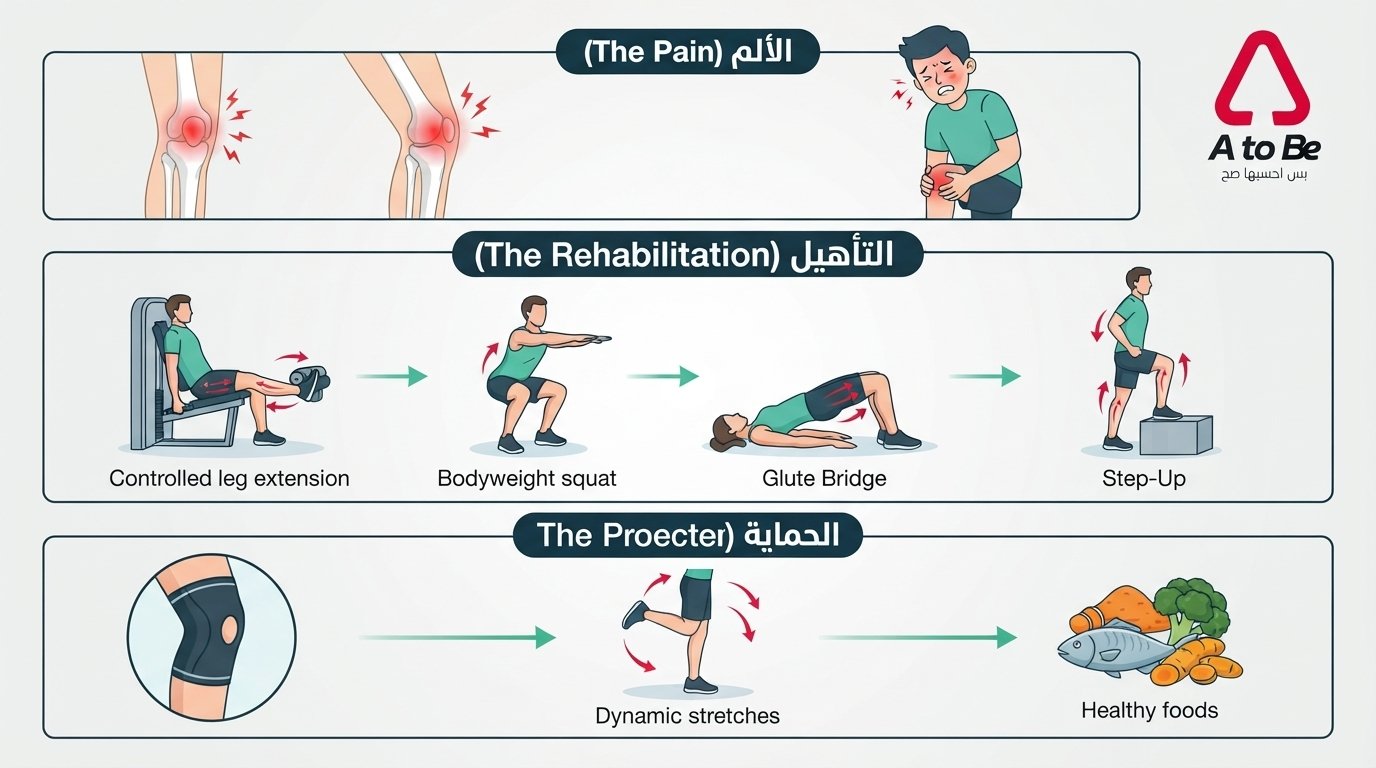
Week 1 — settle it. Drop the painful movements. Start light strengthening: leg extension through a short range, glute bridge. Cold after each session. Stretch daily.
Week 2 — build. Add a little weight to the strengthening work. Add low step-ups. Keep stretching and icing.
Week 3 — return gradually. Bring the squat back, light and through a short range. Add leg press within the safe range.
Week 4 — consolidate. Return to your normal exercises gradually, adding weight slowly. Keep the warm-up and the stretching permanently — they are what stops this recurring.
If the pain is still there after four weeks, stop working around it and see a physiotherapist or a doctor.
The four-week path, from pain to protection.
The short version
Don't stop training entirely — swap what hurts.
Strengthen the quads, hamstrings, calves and glutes.
Fix the technique before adding weight back.
Warm up before and stretch after, permanently.
Listen to the pain. It is information, not something to push through.
Training around an injury?
I write training programs for people managing an injury or a joint that isn't cooperating — built around what your doctor has told you, not around it.
This article is general education, not medical advice. If you have a health condition or a current injury, speak to your doctor before starting any training or nutrition plan.
Cutting Nutrition: How to Lose Fat Without Losing the Muscle
If you are reading this, you have probably finished a bulking phase, or finally decided to deal with the fat that has been hiding the muscle you built.
Cutting is not starving yourself. It is managing calories carefully enough that your body burns fat instead of breaking down the muscle you spent months building.
This is everything you need for a cut that works — written for what is actually available in a Syrian kitchen, and for a realistic budget.
What cutting actually is
A cutting phase is a stretch of time where the goal is to reduce body fat while holding on to as much muscle as possible. Note the wording: the goal is not losing weight. It is losing fat specifically. Those are two different outcomes, and the difference between them is almost entirely protein and resistance training.
Start with your calories
Everything rests on a calorie deficit — eating less than you burn. Here is how to find your starting number.
Maintenance calories
Your bodyweight in kg × 28 to 32, depending on how active you are
A worked example. At 85 kg, maintenance lands somewhere around 2,380 to 2,720 calories. Subtract 300 to 500 from that, and your cutting range is roughly 1,900 to 2,200 calories a day.
Do not start with a bigger deficit than that. A deficit of 300 to 500 is enough, and it is sustainable. Cut harder than that and you lose muscle alongside the fat, your energy in the gym collapses, and you quit by week three.
Protein, carbs and fat
Macronutrient
Per kg of bodyweight
At 85 kg
Protein
2.2 – 2.5 g
187 – 212 g
Carbohydrates
2 – 3 g
170 – 255 g
Fat
0.6 – 0.8 g
51 – 68 g
Protein — this is what protects the muscle
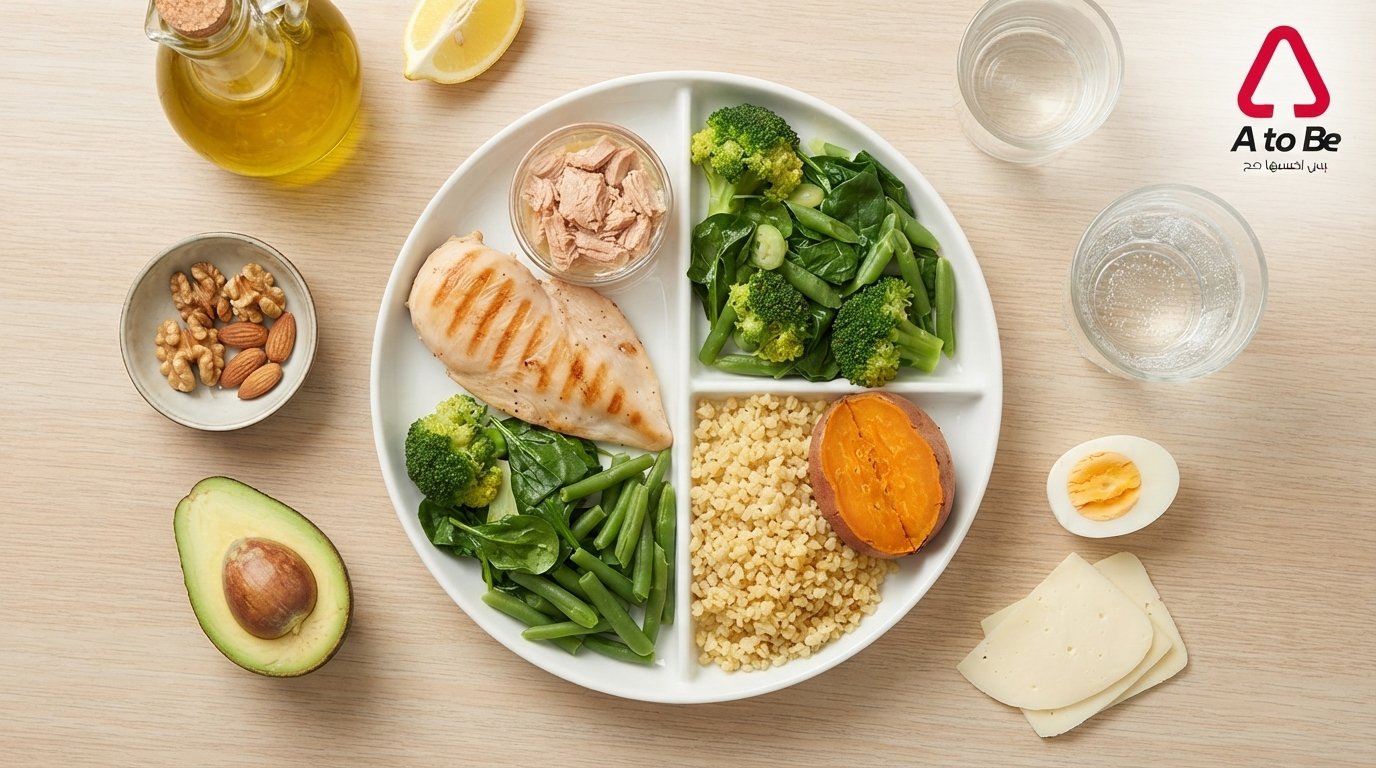
In a deficit, protein is the difference between losing fat and losing muscle. Available and affordable sources here: chicken breast, lean red meat, eggs, canned tuna, light white cheese, sardines, and lentils and chickpeas for plant protein.
Carbohydrates — this is what fuels the training
Oats, white or brown rice, sweet potato, brown bread, and bulgur — which is one of the best local options, cheap and genuinely filling.
Fat — do not cut it to zero
Fat is not optional. Your body needs it to produce hormones, including testosterone. Olive oil, raw walnuts and almonds, avocado, and natural peanut butter.
When to eat
Before training, 1.5 to 2 hours out. Slow carbohydrate plus protein. For example 100 g of rice with grilled chicken.
After training, within the hour. Faster protein and carbohydrate. For example boiled eggs, a slice of brown bread and a banana.
Across the day. Four or five smaller meals rather than two large ones. This keeps hunger manageable and your blood sugar steadier, which matters more than most people expect for how well you stick to the plan.
Water
Three to four litres a day while you are cutting, more if you train hard. Water moves nutrients where they need to go, blunts hunger, and keeps your performance in the gym from dropping — which is what protects your muscle while you are eating less.
Five mistakes that ruin a cut
Cutting fat to zero. It wrecks your hormones and your energy, and it takes muscle with it.
Relying on cardio alone. Most of the result comes from the food. Without a calorie deficit, no amount of running changes anything.
Dropping calories off a cliff. Your body adapts and holds onto fat harder. Lower them gradually.
Ignoring vegetables and fibre. Vegetables fill your stomach for very few calories. Make half your plate vegetables at main meals and the deficit becomes far easier to live with.
Going light on the weights. Keep training at close to the same intensity. Muscle needs a reason to stay, and heavy training is that reason.
An example day at roughly 2,000 calories
This is an illustration of what the structure looks like, not a plan written for you. Your numbers depend on your weight, your training and your goal.
8am — 4 egg whites and 1 whole boiled egg, 50 g oats with cinnamon, green tea without sugar.
11am — 20 g raw almonds, a cup of light yoghurt.
2pm — 150 g grilled chicken breast, 150 g rice or bulgur, a large salad with olive oil and lemon.
5pm, before training — a banana or an apple, a teaspoon of peanut butter.
8pm, after training — a tin of tuna or 150 g grilled fish, a medium boiled potato or 100 g rice, steamed vegetables.
11pm — light yoghurt or cottage cheese.
A note on cutting with diabetes
From my own experience
I live with diabetes myself, and I have run cutting phases while managing it. What has mattered for me: checking my blood sugar regularly, spreading carbohydrates evenly across the day rather than loading them into one meal, choosing lower-glycaemic sources like bulgur, oats and sweet potato, and never running an aggressive deficit.
That is my experience, not a clinical recommendation. A calorie deficit changes how your body handles glucose, and your medication may need adjusting. Talk to your doctor before you start — not after.
The short version
A moderate deficit of 300 to 500 calories, not more.
High protein, every single day. This is what keeps the muscle.
Keep training heavy.
Do not remove fat from your diet.
Give it eight to twelve weeks before you judge the result.
There is no trick here. There is a plan, and there is sticking to it.
Want a cutting plan written for you?
I write nutrition and training programs around your weight, your goal and what you actually eat — with follow-up while you run them.
This article is general education, not medical advice. If you have a health condition or a current injury, speak to your doctor before starting any training or nutrition plan.
The Dumbbell Guide: Building Real Strength at Home or in the Gym
The dumbbell is the smartest and the simplest training tool at the same time. You can use it in the gym, at home, while travelling, in your own garden.
Machines need space, maintenance and money. A pair of dumbbells needs a corner of a room, and gives you freedom of movement and enough exercise variety to cover every level from beginner to advanced.
Here is why the dumbbell belongs in any program, which exercises matter most, and how to build a full week around it.
Why the dumbbell specifically
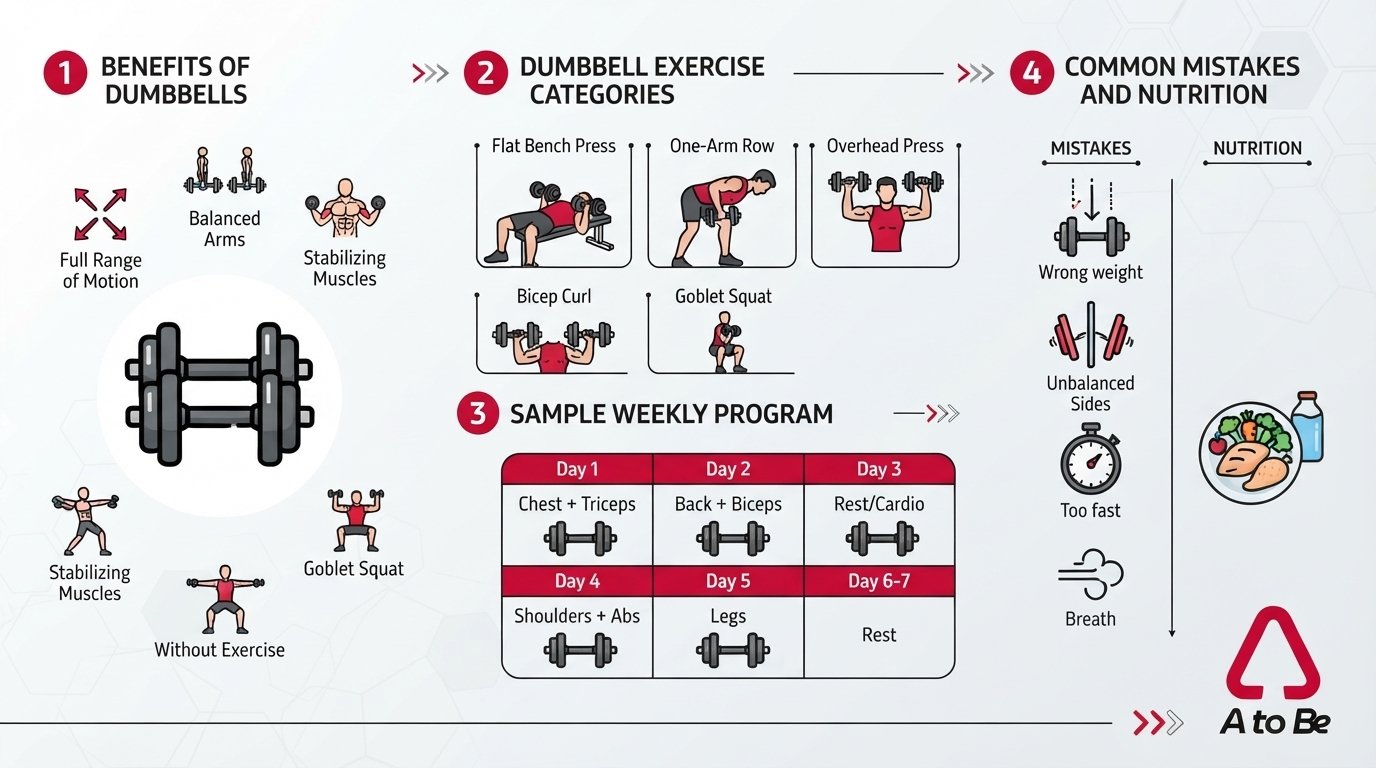
Each arm works on its own. Unlike a fixed barbell, each side moves independently — which exposes the imbalance between your strong and weak side, and then fixes it.
The stabilisers have to work. Holding two separate weights forces your shoulders, arms and trunk to stabilise the load. That stabilising work is what builds usable, whole-body strength rather than isolated size.
A longer range of motion. Dumbbells let you go deeper on a press than a bar does, and that extra range recruits more muscle fibre.
Dozens of exercises from one piece of equipment. There is very little you cannot train with a pair of dumbbells, which is exactly why they are the first thing to buy.
They work at home. A pair of adjustable dumbbells in your room or on your balcony is enough to build serious strength without a gym membership.
Ten exercises that cover the whole body
Muscle
Exercise
What it does
Chest
Flat dumbbell press
The foundation of chest development
Chest
Incline dumbbell press
Targets the upper chest
Chest
Dumbbell flyes
Isolates and stretches the chest
Back
Single-arm row
Builds the back and corrects imbalance
Back
Dumbbell deadlift
Strengthens the lower back and legs
Shoulders
Overhead press
Front and side delts
Shoulders
Lateral raise
Isolates the side delt
Arms
Bicep curl
Builds the biceps
Arms
Overhead triceps extension
Builds the triceps
Legs
Goblet squat
Complete work for quads and glutes
A four-day program using dumbbells only
Day 1 — Chest and triceps
Flat dumbbell press — 4 × 10
Incline dumbbell press — 3 × 12
Dumbbell flyes — 3 × 12
Overhead triceps extension — 3 × 12
Day 2 — Back and biceps
Single-arm row — 4 × 10 per side
Dumbbell deadlift — 3 × 10
Bicep curl — 4 × 12
Alternating curl — 3 × 12
Day 3 — Rest, or light cardio
Day 4 — Shoulders and core
Overhead press — 4 × 10
Lateral raise — 3 × 12
Front raise — 3 × 12
Plank holding a dumbbell — 3 × 45 seconds
Day 5 — Legs
Goblet squat — 4 × 12
Dumbbell lunges — 3 × 10 per leg
Calf raise — 3 × 15
Days 6 and 7 — Rest or light activity
The week at a glance.
Five mistakes people make with dumbbells
Going too light. The weight should be genuinely challenging by the last few repetitions, while your technique still holds. If the last rep looks like the first, it is too light.
Training the two sides unevenly. Count the reps on each side and write them down. Your stronger side will quietly take over if you let it, and the gap widens over months.
Rushing the repetition. Slow and controlled builds more muscle than fast and sloppy. Lower under control; that half of the movement is where most of the growth happens.
Holding your breath. Breathe in as you lower, out as you push. Holding your breath under load spikes your blood pressure and costs you performance.
Skipping the warm-up. Five to ten minutes before you start protects your joints and improves everything you do afterwards.
Notes from rehab work
If something already hurts
Shoulder pain: avoid the deep press and start with a limited range of motion. Lower back pain: do not load the dumbbell deadlift heavily without supervision. Knee pain: there is a full article on training around it in this blog.
If you have diabetes: check your blood sugar before and after training and keep a fast sugar source within reach in case it drops. And talk to your doctor before any large change to how you train.
Stretch after every session. It costs five minutes and prevents most of what sends people to me.
Food still decides the result
Training with dumbbells is not enough on its own. You need enough protein — roughly 2.2 g per kilogram of bodyweight — carbohydrates to fuel the sessions, healthy fats for your hormones, and enough water.
If the budget is the obstacle, the budget article in this blog covers how to hit those numbers cheaply. Without the food side, you will not see the difference in the mirror no matter how well you train.
The short version
Dumbbells are simple and effective enough to build a strong body at home or in a gym.
Ten exercises cover your whole body.
Four sessions a week is enough.
Technique first, weight second.
Watch your nutrition, or none of the above shows.
Want a dumbbell program written for you?
I write training and nutrition programs around your goal, your level and the equipment you actually have — whether that is a full gym or two dumbbells at home.
This article is general education, not medical advice. If you have a health condition or a current injury, speak to your doctor before starting any training or nutrition plan.